Congratulations.
You're Going to Medical School.
NEET helped you earn your place. Now comes a very different journey—learning how to think, learn, communicate and grow as a medical student.
Before College Starts: Complete the Practical Things
Take care of these operational items first so you can arrive at orientation relaxed and focused:
- ✓Complete all physical reporting, fee deposit, and admission formalities within your allotted round window.
- ✓Safely preserve and scan digital backups (cloud/drive) of all submitted certificates, allotment letters, and payment receipts.
- ✓Carefully check your college website for official joining instructions, orientation schedule, and reporting dates.
- ✓Understand hostel room allocation rules, mess arrangements, and what the institution asks students to bring.
- ✓Arrange formal dress code attire and comfortable footwear suited for long hours in hospital wards and dissection halls.
- ✓Avoid rushing to buy every textbook or surgical instrument before receiving guidance from your departmental professors.
The Mindset Shift
MBBS Is Not NEET Part 2
NEET preparation was largely structured around entrance-examination performance—memorizing facts, speed, eliminating negative marking, and competitive ranking.
Medical education is fundamentally different. It progressively requires deep conceptual understanding, connecting bodily systems, clinical communication, ethical responsibility, and teamwork.
“The goal is no longer simply to score enough to enter medicine. You are beginning to learn how to become a doctor.”
Academic Foundations
Meet Your First-Year Pre-Clinical Subjects
Your first year introduces the three classical foundational pillars of medicine:
Anatomy
Understanding the structure of the human body
Explores the architecture of human life through Gross Anatomy, Cadaveric Dissection, Histology (microscopic structures), Embryology (development), and Neuroanatomy.
Physiology
Understanding how the human body works
Investigates the dynamic functional systems—cardiovascular, respiratory, nervous, renal, and endocrine—that maintain homeostasis in health and adapt during disease.
Biochemistry
Understanding the molecular foundations of life
Decodes cellular metabolism, enzyme kinetics, molecular genetics, nutrition, and laboratory diagnostic markers that explain biological processes at a molecular level.
The Complete Doctor
Medical College Teaches More Than Anatomy, Physiology & Biochemistry
The modern Competency-Based Medical Education (CBME) curriculum recognizes that technical knowledge alone does not make a physician:
NMC Foundation Course
A dedicated orientation module at the start of MBBS introducing medical ethics, professional language, hospital systems, and national healthcare goals.
AETCOM (Attitude, Ethics & Communication)
A structured, competency-based curriculum teaching empathy, ethical decision-making, patient dignity, and effective clinical communication.
Professionalism & Medical Etiquette
Developing punctuality, clinical decorum, mutual respect, accountability, and the lifelong identity of being a trusted healer.
Doctor-Patient Communication
Learning how to listen actively, elicit medical histories with sensitivity, and explain clinical situations clearly to patients and families.
Early Clinical Exposure (ECE)
Hospital visits from year one that connect basic science concepts (like heart sounds or kidney function) with real patient encounters.
Essential Lifesaving Skills (CPR)
Hands-on emergency training so you can respond calmly and effectively when every second counts—even before your clinical postings begin.
Personal Growth
Start Building These Habits Early
Seven practical attitudes that help students thrive throughout their 5.5 years and beyond:
Curiosity
— Ask why, not only what.Move from rote memorization to understanding clinical mechanisms. Understanding why a symptom occurs makes medicine memorable.
Consistency
— Medicine rewards regular learning.The sheer volume of medical knowledge is immense. Studying consistently every day prevents overwhelming pre-exam exhaustion.
Communication
— Learn to listen as carefully as you speak.Most clinical diagnoses originate from careful patient history taking. Communication is a clinical skill just like auscultation.
Professionalism
— Your behaviour shapes your medical identity.Respect for cadavers in dissection labs, punctuality in clinics, and integrity with peers lay the groundwork for patient trust.
Teamwork
— Medicine is rarely practised alone.Modern healthcare is delivered by multidisciplinary teams. Learn to collaborate, share knowledge, and support your batchmates.
Empathy
— Patients are people before they are diagnoses.Never reduce a human being to 'Bed Number 4'. Compassion and human dignity are central to true healing.
Lifelong Learning
— Medical education does not end with an exam.Science evolves continuously. Developing habits of reading original evidence and staying curious lasts throughout your career.
Could You Help if Someone Collapsed Today?
You don't have to wait for your final-year emergency posting to learn how to save a life. Cardiopulmonary Resuscitation (CPR) and basic first aid are skills every future doctor can understand from Day One.
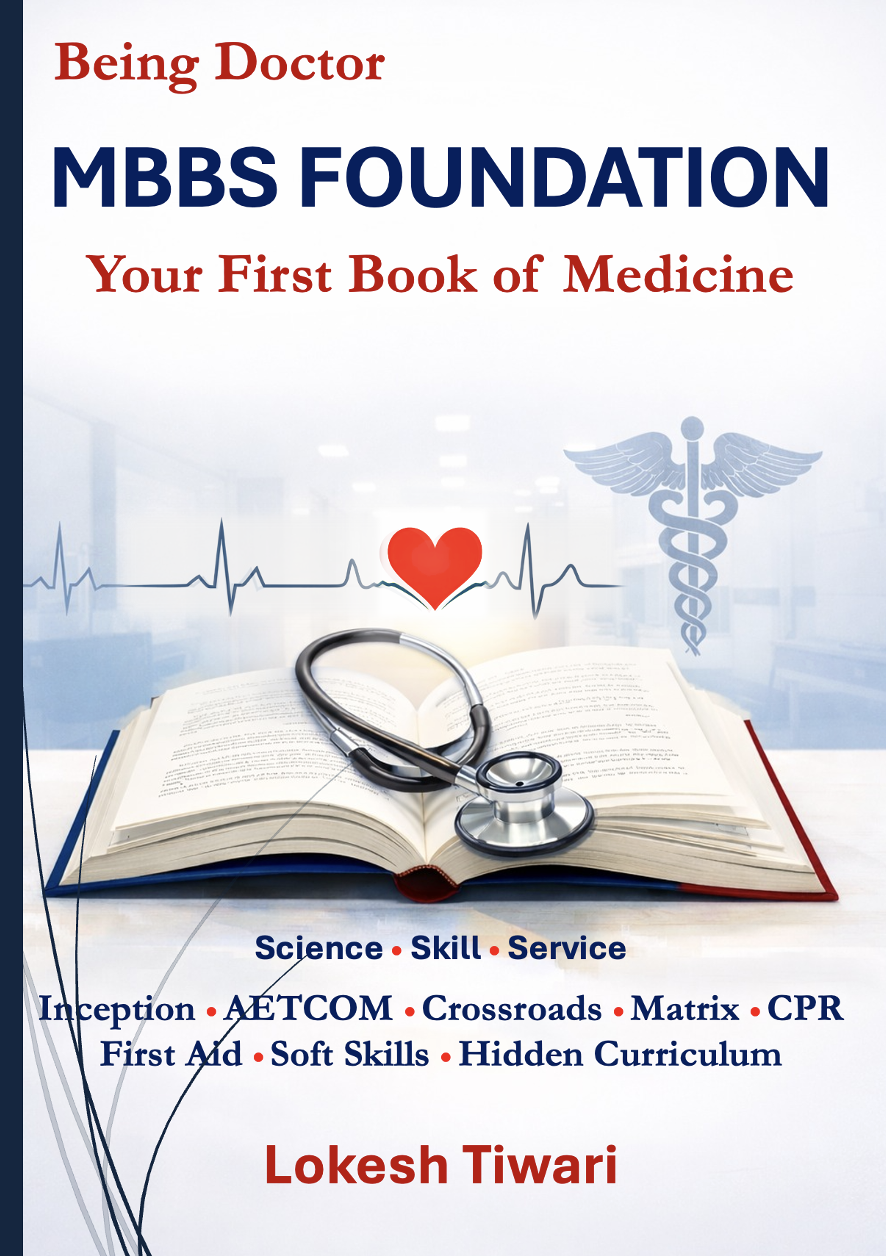
MBBS Foundation:
Your First Book of Medicine
By Dr. Lokesh Tiwari (Clinician, Educator & Professor)
NEET prepared you to enter medical college. MBBS Foundation is designed to help you understand the world you are entering.
Not a replacement for Anatomy, Physiology, or Biochemistry textbooks—it is your personal bridge into medical education, ethics, communication, and clinical thinking.
Why Read It Before or Early in MBBS?
Get oriented to the expectations, vocabulary, and culture of medical college.
Build clinical communication, ethics, and professional conduct from Day One.
Gain practical insights into hostel life, dissection room anxiety, and study balance.
Understand where your first year fits into the larger journey of becoming a compassionate doctor.
A Parent of a New Medical Student?
Mark the beginning of their medical journey with a gift created to help them navigate the profession they are entering.
Still Getting Ready for College?
Download the printable Before Your First Day of MBBS Checklist and Documents Checklist.
Your First Lifesaving Skill
Medical education is about more than books. Basic lifesaving skills are among the earliest practical abilities worth developing before you enter hospital corridors.
Recognizing cardiac arrest and agonal gasping instantly is the critical first link in survival.
High-quality chest compressions and early defibrillation maintain crucial tissue perfusion until circulation returns.
Learning standardized emergency response builds clinical responsibility and readiness from Day One.
Complete the CPR eSanjeevani learning pathway and assessment to earn the programme's applicable certificate, where eligible.
Start CPR eSanjeevani→How Ready Are You for Medical College?
Not another biology test. A 10-question challenge on medical education, clinical ethics, applied human biology, and lifesaving CPR awareness.
The Three Pillars of Medical Readiness
Knowledge • Skills • Mindset
Entering medical college is a holistic transformation. Balance your preparation across all three dimensions before your first day of MBBS.
Prepare for Medical College
Understand first-year basic sciences (Anatomy, Physiology, Biochemistry), Foundation Course, and academic habits with MBBS Foundation.
Learn Your First Lifesaving Skill
Begin learning emergency recognition and Cardiopulmonary Resuscitation (CPR) through the CPR eSanjeevani online module.
Think Like a Future Doctor
Test your clinical reasoning, medical ethics, patient communication, and professional awareness with the Future Doctor Challenge.
A Lifelong Milestone
From NEET Aspirant to Medical Student
Getting the seat is an achievement. What you learn, practise and become from here will define the journey ahead. Welcome to medicine.
Help Your Batchmates
Know Someone Else Starting MBBS?
Share this guide with batchmates or friends who have confirmed their MBBS seats.